Alphonse is assembling an alphabet tree and arranging some adventures along the way.
An alphabet tree is an unrooted tree with $N$ N nodes (numbered from $1$ to $N$) and $N-1$ edges.
Initially, the $i$th edge connects nodes $A_i$ and $B_i$ in both directions, and is labeled with a uppercase letter $C_i$. Two edges incident to a common node are always labeled with different letters.
Alphonse has $Q$ events to process, the $i$th of which is one of two types:
- $1$ $U_i$ $L_i$ : Add a new node to the tree by connecting it to node $U_i$ with a new edge labeled with uppercase letter $L_i$. Newly added nodes are numbered with integers starting from $N + 1$ in the order they're added.
- $2$ $U_i$ $K_i$ $S_i$ : Print the final node Alphonse will end up at if he:
- Starts a journey at node $U_i$.
- Repeatedly traverses a previously untraversed edge (on this journey). If his current node has multiple untraversed edges, he picks the edge labeled with the letter that comes earliest in the string $S_i$.Ends the journey once there are no more untraversed edges at the current node, or $K_i$ edges have been traversed on the journey.
Please help Alphonse determine where each journey will take him.
Constraints
- $1\le T \le 20$
- $2\le N \le 300,000$
- $1\le Q \le 300,000$
- $1\le A_i, B_i \le N$
- $A_i \not = B_i$
- $C_i, L_i, S_{i,j} \in \{'A', \cdots , 'Z'\}$
- $1\le U_i,K_i \le 600,000$
- The sum of $N$ over all test cases is at most $1,100,000$.
- The sum of $Q$ over all test cases is at most $1,100,000$.
For each event, it is guaranteed that:
- $U_i$ is a valid node in the tree at the time of the event.
- $L_i$ is different from all existing labels of edges incident to $U_i$ at the time of the event.
- $S_i$'s letters are distinct, and are a superset of all edge labels in the tree at the time of the event.
Input Format
Input begins with a single integer $T$, the number of test cases. For each test case, there is first a line containing a single integer $N$. Then, $N - 1$ lines follow, the $i$th of which contains space-separated integers $A_i$ and $B_i$, followed by a space, followed by $C_i$. Then, there is a line containing the single integer $Q$. Then, $Q$ lines follow, the $i$th of which is either $1$ $U_i$ $L_i$ or $2$ $U_i$ $K_i$ $S_i$.
Output Format
For the $i$th test case, print a single line containing "Case #i: ", followed by space-separated integers, the answers to all type-2 events.
Sample Explanation
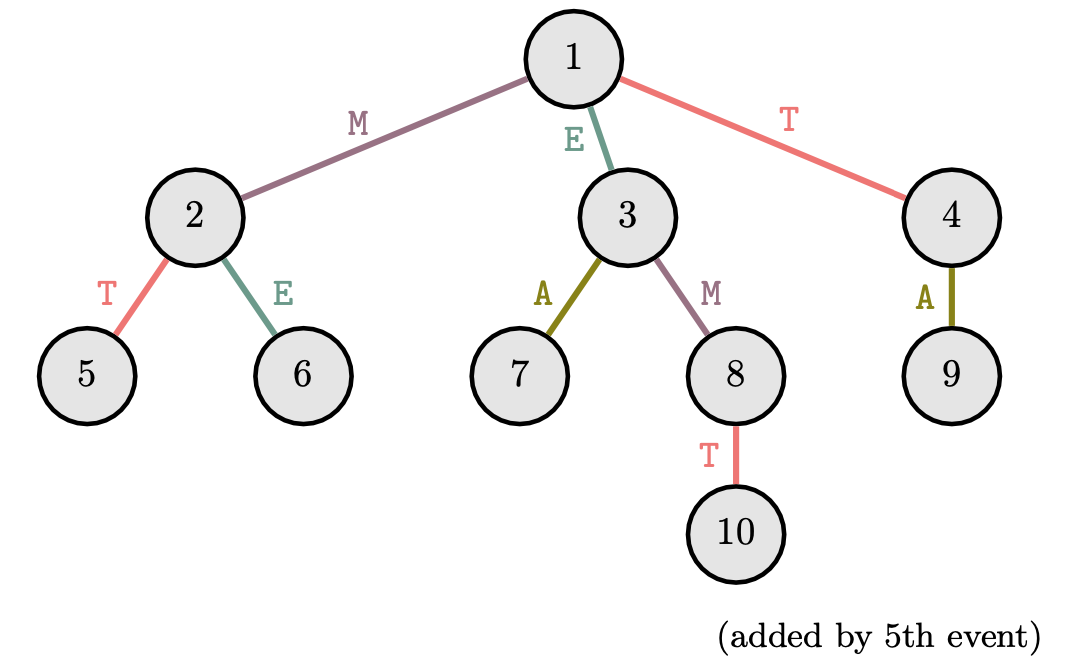
The first sample case's alphabet tree is depicted above, and yields the following journeys:
- Event $1$ traverses $1 \stackrel{\texttt{M}}{\longrightarrow} 2 \stackrel{\texttt{E}}{\longrightarrow} 6$ (ended after no more edges from node $6$)
- Event $2$ traverses $3 \stackrel{\texttt{E}}{\longrightarrow} 1 \stackrel{\texttt{T}}{\longrightarrow} 4 \stackrel{\texttt{A}}{\longrightarrow} 9$(ended after $K_2=3$ steps)
- Event $3$ traverses $9 \stackrel{\texttt{A}}{\longrightarrow} 4 \stackrel{\texttt{T}}{\longrightarrow} 1 \stackrel{\texttt{M}}{\longrightarrow} 2$ (ended after $K_3 =3$ steps)
- Event $4$ traverses $8 \stackrel{\texttt{M}}{\longrightarrow} 3 \stackrel{\texttt{E}}{\longrightarrow} 1 \stackrel{\texttt{T}}{\longrightarrow} 4 \stackrel{\texttt{A}}{\longrightarrow} 9$ (ended after no more edges from node $9$)
- Event $6$ traverses $8 \stackrel{\texttt{T}}{\longrightarrow} 10$ (ended after no more edges from node $10$)
The second and third sample cases are depicted below.
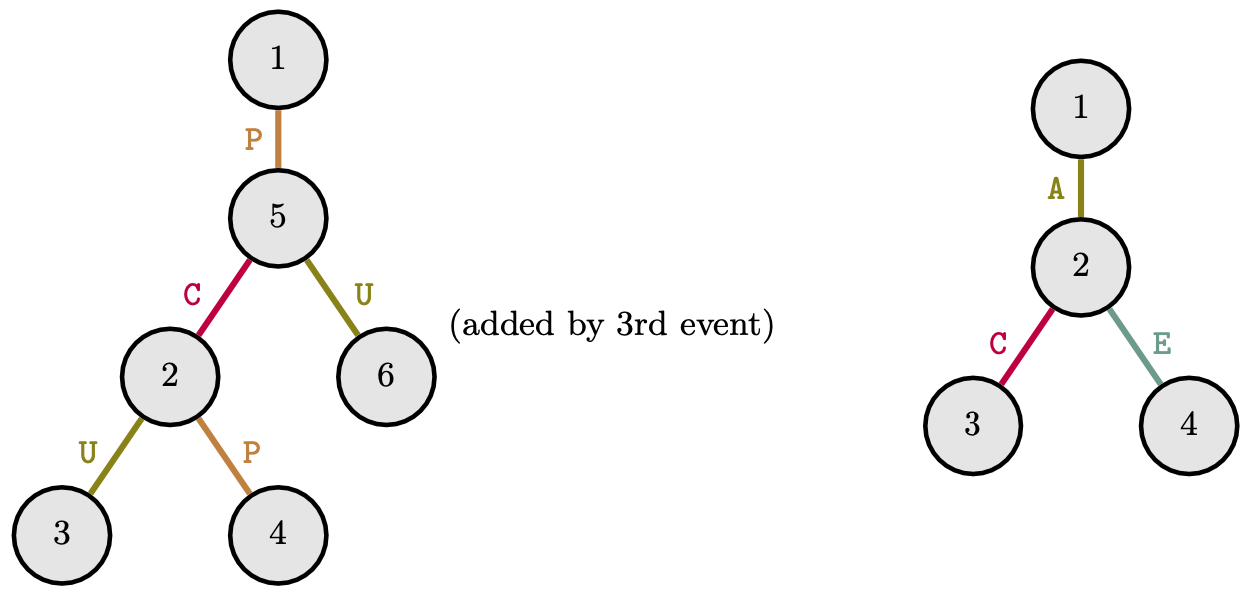
In the second case, the journeys are:
- Event $1$ traverses $1 \stackrel{\texttt{P}}{\longrightarrow} 5 \stackrel{\texttt{C}}{\longrightarrow} 2$ (ended after $K_1 = 2$ steps)
- Event $2$ traverses $4 \stackrel{\texttt{P}}{\longrightarrow} 2 \stackrel{\texttt{C}}{\longrightarrow} 5 \stackrel{\texttt{P}}{\longrightarrow} 1$ (ended after $K_2 = 3$ steps)
- Event $4$ traverses $4 \stackrel{\texttt{P}}{\longrightarrow} 2 \stackrel{\texttt{C}}{\longrightarrow} 5 \stackrel{\texttt{U}}{\longrightarrow} 6(ended after $K_4 = 3$ steps)
- Event $5$ traverses $3 \stackrel{\texttt{U}}{\longrightarrow} 2 \stackrel{\texttt{P}}{\longrightarrow} 4$ (ended after no more edges from node $4$)
In the third case, the journeys are:
- Event $1$ traverses $3 \stackrel{\texttt{C}}{\longrightarrow} 2 \stackrel{\texttt{A}}{\longrightarrow} 1$ (ended after $K_1 = 2$ steps)
- Event $2$ traverses $4 \stackrel{\texttt{E}}{\longrightarrow} 2 \stackrel{\texttt{A}}{\longrightarrow} 1$ (ended after $K_2 = 2$ steps)
- Event $3$ traverses $1 \stackrel{\texttt{A}}{\longrightarrow} 2$ (ended after $K_3 = 1$ steps)
Sample Input
3
9
1 2 M
1 3 E
1 4 T
4 9 A
2 5 T
2 6 E
3 7 A
3 8 M
6
2 1 3 META
2 3 3 TEAM
2 9 3 MATE
2 8 8 TEAM
1 8 T
2 8 8 TEAM
5
1 5 P
5 2 C
2 3 U
4 2 P
5
2 1 2 CPU
2 4 3 CUP
1 5 U
2 4 3 CUP
2 3 4 PUCK
4
2 1 A
2 3 C
4 2 E
3
2 3 2 HACKER
2 4 2 REACH
2 1 1 OCEAN
Sample Output
Case #1: 6 9 2 9 10
Case #2: 2 1 6 4
Case #3: 1 1 2